This blog serves CMC Government 191, Public Policy Since the New Deal, Fall 2025. During the semester, I shall post course material and students will comment on it. Students are also free to comment on any aspect of American politics, either current or historical. There are only two major limitations: no coarse language, and no derogatory comments about people at the Claremont Colleges. This blog is on the open Internet, so post nothing that you would not want a potential employer to see
Voters in the U.S. and around the worldare unhappy with the direction of their countries and keep voting to “throw the bums out”. In the U.S. there were just 3 change elections (where the party controlling the House, Senate and/or White House changed) out of the 10 held in the 1960’s & 70s. In the 80’s & 90’s it happened 4 times in 10 elections. This century? 11 out of 13 elections.
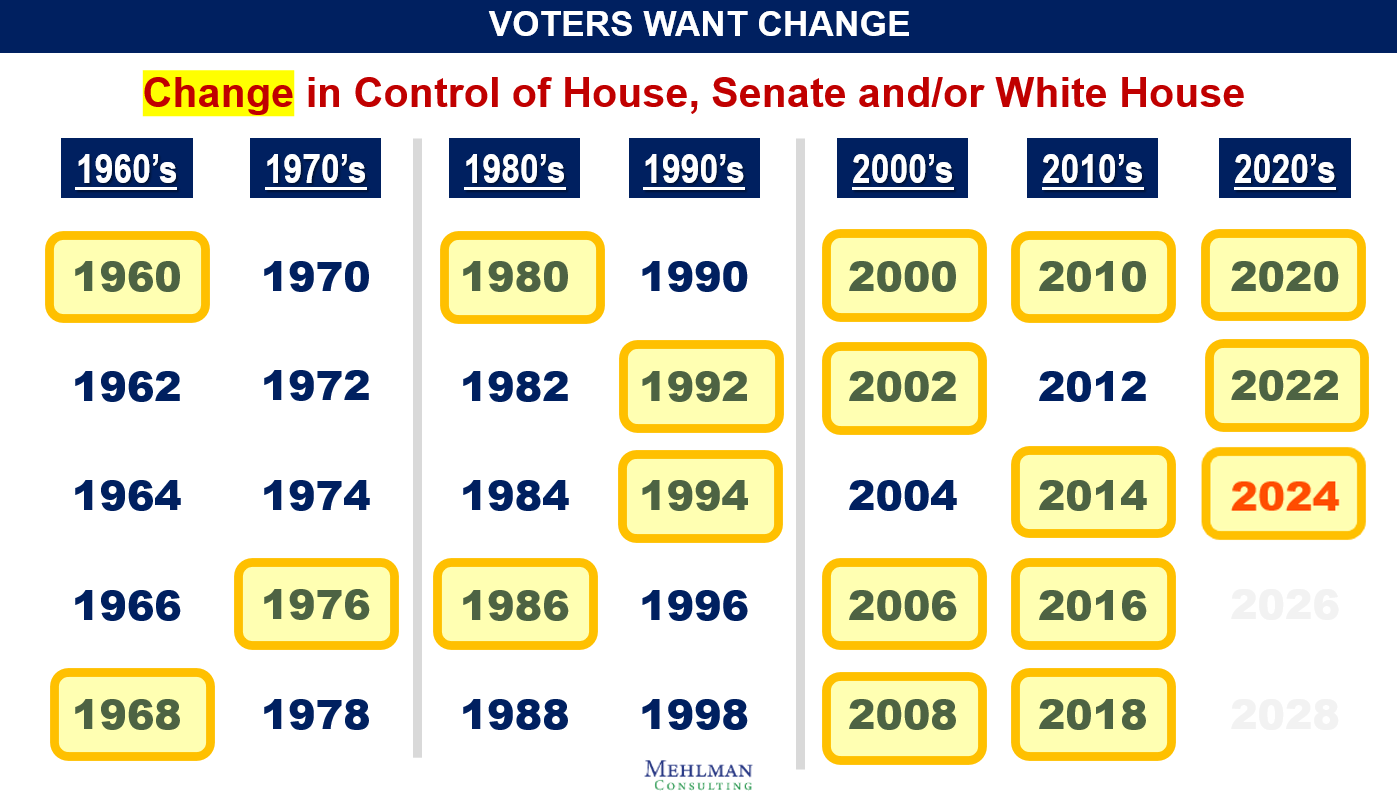
One reason is partisan parity (scroll down to see data on leaned partisanship.)
The following will give you an idea of the format of the final exam. As you prepare, reread the air midterm and the Johnson appendices that I emailed you.
I. Briefly identify 12 of 14 items (4 points each). Explain each item's meaning and significance. What is fair game for an identification?
Items that we have covered in class or on the blog;
Items that appear in bold or italics in the readings;
Items that cover several pages in the readings.
Items
ACA premium subsidies
Hurricane Katrina
Robert F. Wagner
No Child Left Behind
Defense of Marriage Act
Family Assistance Plan
Presidential line-item veto
Title IX
Taft-Hartley
NEPA
Tea Party
The Laffer Curve
Stagflation
The Townsend Plan
II. Short essays. Answer three of four. Each answer should take about half a page. (6 points each).
Why did Bush and Gore support faith-based initiatives in 2000?
Why did Joseph Califano oppose the establishment of the Department of Education?
Why did Truman succeed with desegregating the armed forces but not achieve national health insurance?
David Stockman said: "None of us really understands what’s going on with all these numbers." Explain.
III. Answer two of three essay questions (17 points each). Each answer should take about 2-3 large bluebook pages or 3-4 small bluebook pages.
During the course, we have often discussed the unanticipated consequences of public policy. Describe and explain three examples.
"The thing that hath been, it is that which shall be; and that which is done is that which shall be done: and there is no new thing under the sun" (Ecclesiastes 1:9). Explain how this passage describes the cyclical character of federal education policy.
Compare and contrast the federal response to the Great Depression and the Great Recession. Did policymakers apply lessons from the first to the second?
Bonus Questions (one point each). Very briefly identify the following:
Economic Recovery Act and the difficulty of implementation
Obama on construction:
December 15, 2008: "We've got shovel-ready projects all across the country that governors and mayors are pleading to fund. And the minute we can get those investments to the state level, jobs are going to be created."
September 27, 2010: "But the problem is, is that spending it out takes a long time, because there's really nothing -- there's no such thing as shovel-ready projects."
Policy Window: unified control of government and brief supermajority in the Senate
Path Dependency: Adding onto existing insurance, not replacing it
Health Insurance Marketplaces: The law established state-based Health Insurance Marketplaces (also known as exchanges) where individuals and families can compare and purchase private health insurance plans
Premium Tax Credits: The ACA provides tax credits on a sliding scale to help make insurance premiums affordable for eligible individuals and families purchasing coverage through the Health Insurance Marketplace. Enhanced credits in 2021, just expired.
Medicaid Expansion: The law offered states the option to expand their Medicaid programs to cover nearly all low-income adults under age 65, significantly extending health coverage to millions who were previously uninsured.
Young Adult Coverage: One of the most popular provisions allows young adults to remain on a parent’s health insurance plan until they turn 26, which is particularly beneficial as they often have limited income after high school or college.
Preventive Services Without Cost: The ACA mandates that most health insurance plans cover a broad range of preventive services, such as vaccinations, screenings, and counseling, at no extra cost to the patient (no copayment or coinsurance).
Guaranteed Issue and Renewability: The ACA prohibits insurers from denying coverage or charging more based on a person's pre-existing health conditions, ensuring access for everyone regardless of their health history
Once again, the problem of overpromising
June 13, 2009: "If you like your plan and your doctor, you can keep them. The only changes that you'll see are lower costs and better health care."
Q: At this point, though, it''s obviously something — a promise that has not been able to be kept. Just today the Denver Post reported 250,000 people in Colorado are seeing health insurance policies cancelled. Some of those people like those policies, and they can''t keep them. What happened?
A: But even though it''s a small percentage of folks who may be disadvantaged, you know, it means a lot to them and it''s scary to them. And I am sorry that they, you know, are finding themselves in this situation, based on assurances they got from me.
"Uniting and Strengthening America by Providing Appropriate Tools Required to Intercept and Obstruct Terrorism (USA PATRIOT) Act of 2001." (Johnson 364-365)
Expanded Surveillance and Search Authority: The act expanded law enforcement's ability to surveil communications, including domestic and international wiretaps, and allowed for secret "sneak and peek" searches .
Increased Information Sharing: It broke down legal barriers that had kept law enforcement, intelligence, and national defense agencies from sharing information, allowing them to "connect the dots" to prevent attacks.
Strengthened Anti-Money Laundering and Financial Controls: The act implemented stricter anti-money laundering measures, such as customer identification requirements for U.S. banks and expanded scrutiny of high-risk accounts, to hinder the financing of terrorism.
Tocqueville's warning that "any alliance with any political power whatsoever is bound to be burdensome for religion. It does not need their support in order to live, and in serving them it may die."
Medicare Prescription Drugs (Johnson 367-368):
Social Security reform flops in 2005.
Bush thought his narrow victory was a mandate. It wasn't.
Deficit had gone from $128b in FY2001 to $413b in FY2004.
Black-Koopman reading for Wed: Of Little Faith excerpt
Prelude: The Election of 2000
In his memoirs, Karl Rove recalled: “What really matters is the first 180 days, because voters look for real achievements by the August recess. Most pieces of legislation need to be well along by then if they are to pass in the president’s first year.”
The cut (Johnson 362-363)
Why kick off with a tax cut?
Informal adviser to Bush 41
1994 race for Governor of TX: “Read my
ears.There will not be a tax increase
when I'm the governor.” The boom helped him keep the promise.
In his campaign book, he wrote:“Reducing marginal tax rates will increase
economic growth and create higher-paying jobs. By returning money to the
taxpayers, we can also limit government. Money returned to Americans will not
be spent on new or expanded government programs.”
OMB Director Mitch Daniels: “ So even by the time of the tax cut the rationale was beginning to shift to fighting recession. I always thought it was maybe the luckiest fiscal move that we’ve seen. Again, it was crafted for a different reason. It came into effect at about the right time and it turned out to be a very mild recession. That probably helped.”
Bipartisan majorities passed a $1.35 trillion tax cut spread over 10 years.
Bush legislative staffer Jack Howard: "There was a real conscious effort, up until 9/11, to try to find, who is that Democratic dealmaker out there that I can work with?”
Rep. George Miller (D-CA), ranking D on Education & Workforce: on how he and Ted Kennedy worked with Bush: "There was no question that we flew cover for this with the center-left crowd—and John Boehner flew a great deal of cover, obviously George Bush, with conservatives who saw this as a massive intrusion, with all of the testing, the reporting."
Passes in 2002:
Annual testing and standards: NCLB mandated that states establish "challenging" academic standards and test all students annually in reading and math in grades 3-8 and once in high school to measure progress.
Accountability and reporting: Schools had to report test results publicly, disaggregated by race, income, disability, and other subgroups. This was to hold them accountable for the performance of all students, especially those who were underperforming.
Teacher qualifications: States were required to ensure all students had access to "highly qualified" teachers, with each state defining what that meant for their teachers.
Parental options: Parents of students in schools that failed to meet state standards for two consecutive years were given the option to transfer their children to a better-performing public or charter school.
Support for struggling students: Children from low-income families in schools that failed to meet standards for three years or more qualified for supplemental educational services, such as free tutoring
"Uniting and Strengthening America by Providing Appropriate Tools Required to Intercept and Obstruct Terrorism (USA PATRIOT) Act of 2001." (Johnson 364-365)
Expanded Surveillance and Search Authority: The act expanded law enforcement's ability to surveil communications, including domestic and international wiretaps, and allowed for secret "sneak and peek" searches .
Increased Information Sharing: It broke down legal barriers that had kept law enforcement, intelligence, and national defense agencies from sharing information, allowing them to "connect the dots" to prevent attacks.
Strengthened Anti-Money Laundering and Financial Controls: The act implemented stricter anti-money laundering measures, such as customer identification requirements for U.S. banks and expanded scrutiny of high-risk accounts, to hinder the financing of terrorism.
Reaction to the tax increase and failed health bill
Ironically, GOP control of the White House suppressed GOP gains downballot.
The Contract with America (Johnson 327-328)
Before 1994 ElectionAfter GOP Gain
House176 R 258 D230 R-204D +54
Senate 44R-56D 52R-48D +8
Governors 20R-29D 30R-19D +10
Leg. Chamber 14 31 +17
The Contract:
1. Fiscal Responsibility Act (Balanced Budget Amendment & Line-Item Veto)The Balanced Budget Amendment passed the House but failed by one vote in the Senate. The Line-Item Veto Act passed in 1996 but was struck down by the Supreme Court in Clinton v. City of New York (1998).See Johnson 342-343.
2. Taking Back Our Streets ActContained anti-crime measures like increased prison funding and “truth in sentencing.” Parts were enacted through the 1996 crime legislation, but not as a single comprehensive law.
3. Personal Responsibility ActAimed to end welfare “as we know it.” After several vetoes, a modified version became the Personal Responsibility and Work Opportunity Reconciliation Act of 1996, replacing AFDC with TANF.(Johnson 334-335)
4. Family Reinforcement ActPromoted tax incentives for families and tougher child support enforcement. Some provisions—.e.g, child support reforms—were enacted, but broader family and adoption measures failed.
5. American Dream Restoration ActProposed a $500-per-child tax credit and tax cuts for married couples. Versions were in the Taxpayer Relief Act of 1997, creating the child tax credit.
6. National Security Restoration ActSought to strengthen defense and restrict U.N. control over U.S. troops. Passed the House but not the Senate; many elements resurfaced in later defense appropriations bills.
7. Senior Citizens Fairness ActProposed raising the Social Security earnings limit and repealing the 1993 tax on Social Security benefits. Some earnings-limit changes passed in 1996; benefit-tax repeal failed.
8. Job Creation and Wage Enhancement ActFocused on capital gains tax cuts and regulatory reform. Partial capital gains cuts were in the 1997 tax lawd
9. Common Sense Legal Reform ActAimed to limit product-liability lawsuits and curb “frivolous” litigation. Passed Congress but vetoed by President Clinton.
10. Citizen Legislature Act (Term Limits)Proposed constitutional amendment to limit congressional terms. Failed in the House (227–204, short of two-thirds).
The 1978-79 Iranian Revolution deposes the Shah, disrupts global oil supply and triggers a recession.
In 1979, Iranian students take US embassy workers hostage. The crisis lasts 444 days. An attempt at rescue ends in humiliating failure.
Reagan wins, GOP takes the Senate for the first time since 1952 and makes major gains in the House.
A policy window opens -- but for what?
"In private, Stockman agreed that his former congressional mentor, John Anderson, running as an independent candidate for President in 1980, had asked the right question: How is it possible to raise defense spending, cut income taxes, and balance the budget, all at the same time?"
In this present crisis, government is not the solution to our problem; government is the problem.
Minutes later, a less-remembered line
Now, so there will be no misunderstanding, it's not my intention to do away with government. It is rather to make it work -- work with us, not over us; to stand by our side, not ride on our back. Government can and must provide opportunity, not smother it; foster productivity, not stifle it.
Shift in GOP Economic Policy
Republicans had not always been tax cutters. In the second 1960 debate, Nixon said:
I think it may be necessary that we have more taxes. I hope not. I hope we can economize elsewhere so that we don’t have to. But I would have no hesitation to ask the American people to pay the taxes even in l961 – if necessary – to maintain a sound economy and also to maintain a sound dollar
The inflation of the 1970s created "bracket creep."
Jack Kemp and the Kemp-Roth tax bill: 30% across-the-board cut in income taxes. Takes off after the overwhelming victory of California's Prop 13 shows the appeal of tax cuts.
The Laffer Curve:
March 18, 1981, Reagan survives an assassination attempt and his approval rating jumps 8 points.
OBRA: purported to cut federal spending by an estimated $130.6 billion over three years by cutting funding for many social programs.
But ... Baseline budgeting:
There was less there than met the eye. Nobody has figured it out yet. Let’s say that you and I walked outside and I waved a wand and said, I’ve just lowered the temperature from 110 to 78. Would you believe me? What this was was a cut from an artificial CBO base. That’s why it looked so big. But it wasn’t. It was a significant and helpful cut from what you might call the moving track of the budget of the government, but the numbers are just out of this world. The government never would have been up at those levels in the CBO base.”
Across-the-board 23% cut in individual income tax rates over three years. It also reduced the top marginal tax rate for individuals from 70% to 50% and lowered corporate and capital gains taxes.
Accelerated depreciation: The act introduced the Accelerated Cost Recovery System (ACRS), which allowed businesses to write off the costs of their assets over a shorter period. This was intended to stimulate business investment and economic growth.
1982
Contractionary monetary policy triggers a deep recession, topping at 10.8 percent, still the highest since the Great Depression.
Scroll up to see the deficit graph again.
Reagan agrees to tax hikes:
The Tax Equity and Fiscal Responsibility Act of 1982 had several key provisions, including an increase in the federal unemployment tax wage base and tax rate.
The Highway Revenue Act of 1982 raised the gasoline excise tax from 4 cents to 9 cents through the fall of 1988.
The Social Security Amendments of 1983 sped up increases in the payroll tax rate and provided for the taxation of some Social Security benefits.
The Deficit Reduction Act of 1984 reduced tax benefits from income averaging and extended telephone excise tax through 1987.
The Consolidated Omnibus Budget Reconciliation Act of 1985 permanently raised the cigarette excise tax to 16 cents per pack.
Omnibus Budget Reconciliation Act of 1987 extended the telephone excise tax through 1990 and eliminated the estate tax deduction loophole for employee stock ownership plans.